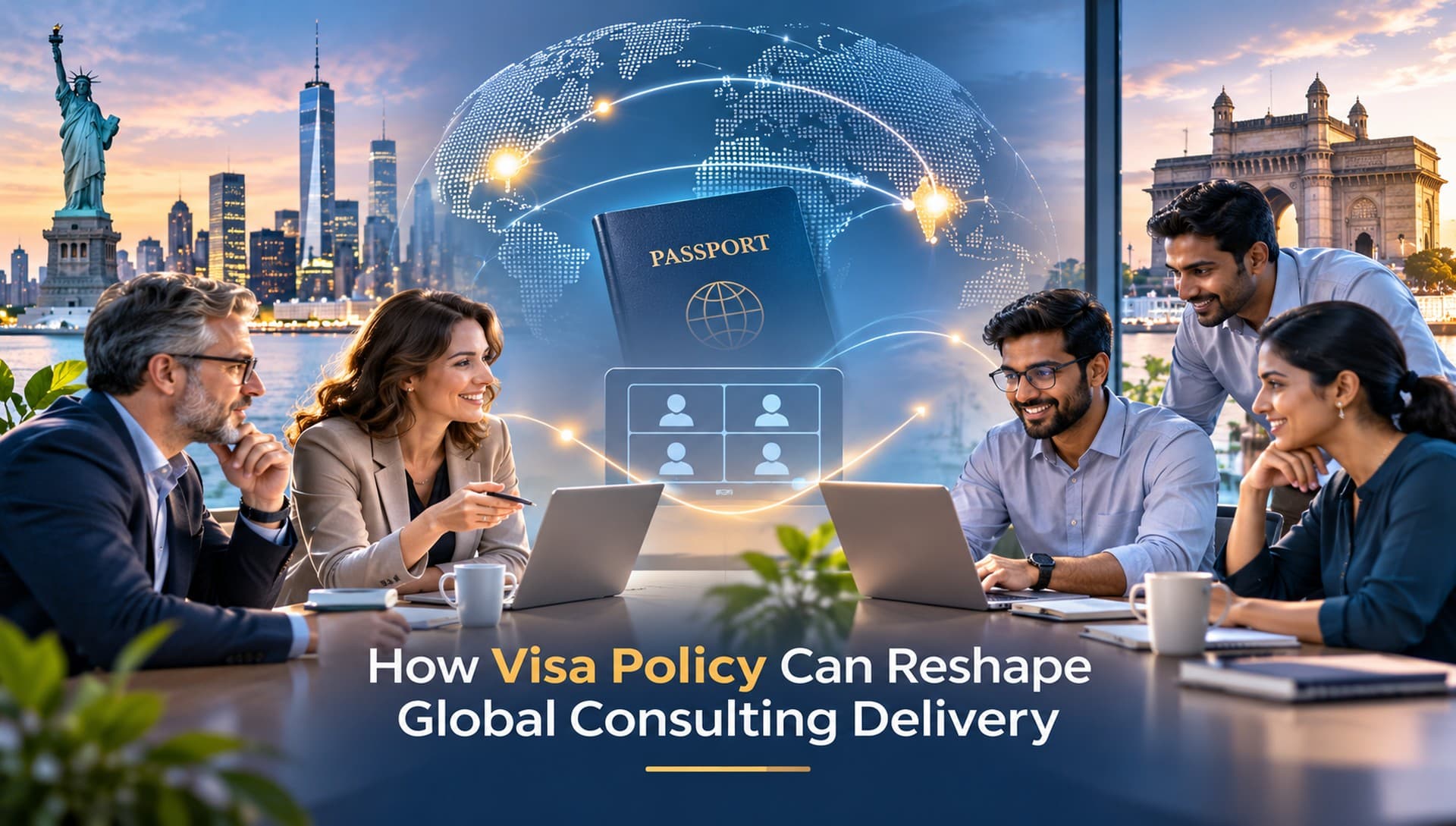

How Visa Policy Can Reshape Global Consulting Delivery
Imagine a consulting firm wins a project to modernise a US manufacturer's finance operations. It needs people who understand accounting, business processes, technology and change management. Some must work closely with the client's leadership; others can design, configure and test systems from another country.
Now imagine that moving some of those specialists to the United States becomes more difficult. The client's business problem has not changed. The expertise required has not disappeared. But the consulting firm may need to reconsider where its people work, how they collaborate and who takes responsibility for each part of the engagement.
That is the business question behind a recent report about IBM. An Indian Express article reports changes to H-1B and green-card sponsorship for most affected US consulting roles, with relocation or exit options described for affected employees. The original company communication, precise scope and affected employee count have not been independently verified for this draft. The reported employer decision should not be confused with a change in US immigration law, nor assumed to apply to the entire consulting industry.
Nevertheless, it provides a useful lens through which to understand how workforce mobility influences global consulting delivery.
Why consulting firms move people across borders
Consulting is not simply the sale of hours. Clients buy expertise to solve business problems, manage risk, improve performance or implement change. A firm's challenge is to assemble that expertise in a way that delivers results at an acceptable cost.
Historically, one approach has been to move specialists temporarily or for longer assignments to the country where a client operates. Being physically close to the client can help consultants understand organisational context, facilitate workshops, resolve ambiguity and build relationships.
Other work can be performed from a different location. Research, data analysis, software configuration, testing, financial modelling and documentation often lend themselves to distributed collaboration, subject to contractual, security and regulatory requirements.
Visa sponsorship is one mechanism that can enable international mobility. The US H-1B category concerns temporary employment in qualifying specialty occupations, while employment-based permanent residence is a distinct immigration process. An employer's willingness to sponsor either can influence staffing decisions, but sponsorship alone does not guarantee immigration approval.
When mobility becomes less predictable or an employer changes its sponsorship approach, the firm must examine which activities genuinely require physical presence and which can be delivered effectively through other arrangements.
From moving talent to connecting talent
Consider a hypothetical consulting engagement to implement an enterprise resource planning system for a US client.
A locally based team could lead stakeholder discussions, understand the client's operating model and manage sensitive change decisions. A team in India could contribute to process design, solution architecture, configuration, testing and data migration. Specialists in both locations could participate in solutioning and design reviews.
The distinction is not that local teams think while offshore teams execute. A mature distributed model can involve experts in both locations throughout the engagement, with responsibilities determined by capability, client needs and delivery constraints.
Such an approach requires more than video calls. Teams need common methods, clear accountability, secure access to information, shared documentation and effective handovers. They must also agree on who makes decisions and who resolves problems when client requirements change.
Some work may still need local presence because of client preferences, confidentiality, contractual obligations or regulatory requirements. Remote delivery is therefore an option to evaluate, not a universal replacement for international assignments.
Where global capability centres fit
Global capability centres, or GCCs, are enterprise-owned operations that provide capabilities to their parent organisations. Consulting firms may similarly operate integrated delivery centres that support client engagements across markets. These models are related, but not identical: a third-party consulting delivery centre serves the firm's client business, while a typical GCC primarily serves its own enterprise.
Both can illustrate how organisations develop specialist expertise across geographies rather than depend entirely on moving individuals to a single market.
A mature centre can contribute to research, solution development, engineering, analytics, risk assessment and programme management. Its value depends on the work it owns and the outcomes it supports, not merely the number of employees or the difference in salary costs.
Changes in workforce mobility could encourage firms to examine these capabilities more closely. But a reported sponsorship decision by one company is not evidence that consulting jobs will automatically move to India or that GCC hiring will increase. Such outcomes depend on client demand, skills availability, delivery economics and the firm's strategy.
The economics of a distributed consulting model
Consulting leaders must balance revenue, delivery cost, utilisation, quality and client satisfaction. International assignments may involve relocation, immigration administration and travel expenses. Distributed delivery can reduce some of those costs, but may introduce additional coordination, management and technology requirements.
Imagine a hypothetical firm transfers a workstream to a remote team to reduce staffing costs. If requirements are poorly communicated, the team may produce work that needs repeated correction. Delays and rework can erode the expected savings and damage the client relationship.
A better business measure is total delivery cost relative to the quality and timeliness of the outcome. That includes the cost of collaboration, specialist availability, knowledge transfer, compliance and continuity, not just hourly rates.
This is why the location of a consultant cannot be the only consideration. The firm must design the engagement around the work, the client and the expertise required.
What changes for consulting careers?
For professionals, the most important distinction is between demand for a skill and the ability to perform a job in a particular country.
A consultant may possess valuable expertise even if a specific employer cannot or will not sponsor an international assignment. Equally, remote working arrangements do not automatically remove immigration or employment-law requirements.
As delivery models evolve, technical expertise remains important, but other capabilities can become increasingly valuable: understanding a client's industry, translating business problems into solutions, communicating with stakeholders, managing distributed projects and taking ownership of outcomes.
A finance consultant who understands manufacturing economics can contribute more effectively to a factory transformation. A technology specialist who understands banking processes can help shape a solution rather than simply configure software. A programme manager who can coordinate teams across locations can help prevent delivery fragmentation.
For early-career professionals, this means developing a career identity around the problems they can solve, not solely around the geography in which they hope to work. For experienced consultants, it means building the ability to lead engagements and relationships across organisational and national boundaries.
These are possible learning implications, not predictions about individual employment or visa eligibility.
The bigger shift: global expertise without constant relocation
Visa sponsorship is one of several factors influencing consulting delivery, alongside technology, client expectations, labour markets and business economics. It may change the options available to employers and employees, but it does not remove the need for expertise or guarantee a particular delivery model.
The real strategic question for consulting firms is whether they can connect specialists across locations without weakening client trust, accountability or delivery quality.
A global consulting firm is not defined simply by how many countries its people travel to. It is defined by how effectively it brings expertise from different countries together to solve a client's problem.
SOURCE
Indian Express, https://indianexpress.com/article/world/us-news/ibm-ends-h-1b-green-card-sponsorship-for-most-us-consulting-roles-impact-on-indians-10979852/
Disclaimer
This article is intended solely for educational, informational and industry awareness purposes. It is based on publicly available information and independent interpretation to help readers understand industries, business models, technologies and emerging career opportunities.
The views, interpretations and illustrative examples presented do not constitute official positions, endorsements or recommendations by Omnivance or any organisations referenced. References to companies, brands, individuals and transactions are for educational and contextual purposes only and do not imply any affiliation or endorsement.
While reasonable efforts are made to ensure accuracy, Omnivance makes no warranties regarding the completeness, accuracy or continued relevance of the information. This content does not constitute investment, financial, legal or other professional advice. Readers should independently verify information before making business or professional decisions.
To the extent permitted by applicable law, Omnivance shall not be liable for losses arising from reliance on this content.
If you have concerns regarding factual accuracy, attribution, intellectual property or any other aspect of this article, please contact us. We will review legitimate concerns and take appropriate corrective action, including correction or removal of content where warranted.
Tags
Share this article

Omnivance Research Team
Dedicated to bridging the gap between education and industry requirements.
Related Courses
Deepen your knowledge with these recommended courses